China to Philippines: Sea Freight CBM and Air Freight Chargeable Weight Explained
Understand how PGH calculates chargeable CBM for sea freight loose cargo and chargeable weight for air freight, with clear formulas, examples and the shipment details needed for an accurate quote.

How does the logistics industry usually calculate chargeable volume and chargeable weight?
For PGH Express shipments from China to the Philippines, chargeable volume for all sea freight loose-cargo shipments (excluding FCL) is the highest of the actual packed volume in CBM, total gross weight in kg divided by 500, and the standard 0.3 CBM minimum. Air freight chargeable weight is the higher of actual gross weight and volumetric weight, then rounded up to the next 0.1 kg.
For cartons with the same packed dimensions, volumetric weight is calculated as follows: Volumetric weight (kg) = packed length (cm) × packed width (cm) × packed height (cm) × number of cartons ÷ 6,000
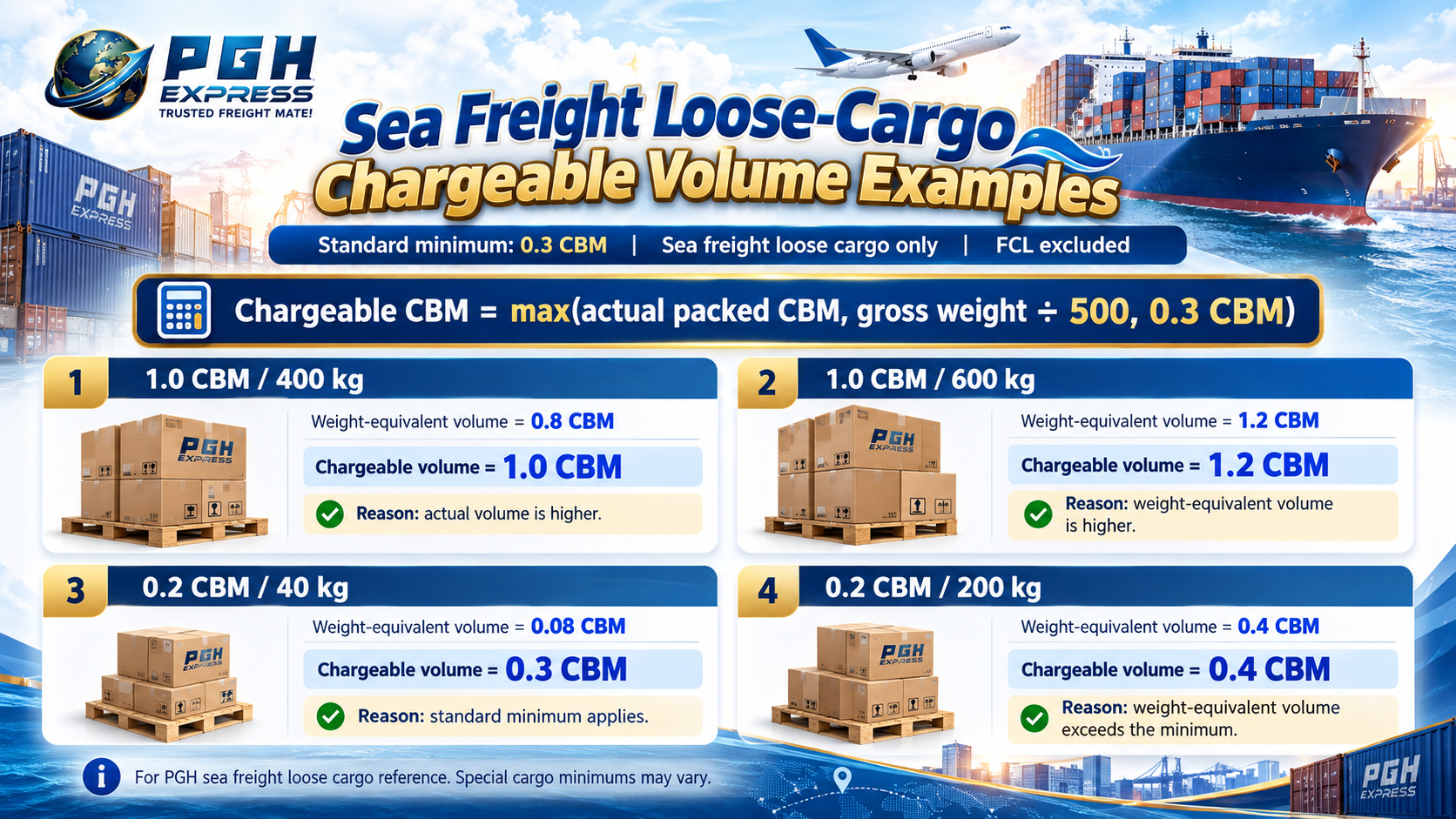
That explains both situations: a 1 CBM sea freight loose-cargo shipment weighing 600 kg is charged as 1.2 CBM, while a light air shipment may have a higher chargeable weight because its packaging occupies more space.
The sea freight conversion applies to all PGH loose-cargo sea shipments. It does not apply to full-container-load (FCL) bookings; ask PGH for the applicable FCL quotation basis. These calculations follow PGH rules and are not a universal standard for every freight provider. All examples are illustrative and are not records of actual customer shipments.
How PGH calculates sea freight loose-cargo chargeable volume
For all PGH sea freight loose-cargo shipments, excluding FCL, PGH uses a weight-to-volume conversion of 500 kg per 1 CBM. CBM means cubic metre. Divide the shipment’s total gross weight by 500 to obtain its weight-equivalent volume, then compare that figure with the actual packed volume and the standard 0.3 CBM minimum. You can also review PGH sea freight services for the full shipping process and service scope.
Weight-equivalent volume in CBM = total gross weight in kg ÷ 500
Standard sea loose-cargo chargeable CBM = max(actual packed CBM, total gross weight in kg ÷ 500, 0.3 CBM)
The standard minimum is 0.3 CBM. Special cargo may have different minimum billing requirements, including a higher minimum chargeable volume. Ask PGH to confirm the applicable minimum before dispatch. The examples below assume the standard 0.3 CBM minimum. If a higher minimum is confirmed, use that value instead of 0.3 CBM in the comparison. This does not change the gross weight ÷ 500 conversion and does not make this formula applicable to FCL.
For identical cartons, calculate actual packed volume as length × width × height in centimetres × number of cartons ÷ 1,000,000. For cartons of different sizes, calculate the volume of each carton or size group and add the results. Measure the external dimensions after packing, including any crate or pallet used.
The 500 kg conversion is a billing basis, not a statement that 1 CBM cannot physically weigh more than 500 kg. If the weight-equivalent volume is higher than the actual volume, the higher figure becomes the chargeable volume. The physical dimensions of the shipment have not changed.
Sea freight loose-cargo examples with the standard 0.3 CBM minimum
How PGH calculates air freight chargeable weight
Air freight chargeable weight is determined by comparing actual gross weight with volumetric weight. Actual gross weight is the weight of the goods together with their packaging. Volumetric weight converts the space occupied by the packed shipment into a billing weight. You can also review PGH air freight services for the full shipping process and service scope.
For cartons with the same packed dimensions, volumetric weight is calculated as follows:
Volumetric weight (kg) = packed length (cm) × packed width (cm) × packed height (cm) × number of cartons ÷ 6,000
Air freight chargeable weight (kg) = the higher of total gross weight and total volumetric weight, then rounded up to the next 0.1 kg
For cartons of different sizes, calculate the volumetric weight of each carton or each group of identical cartons separately, add the results, and then compare the total volumetric weight with the total gross weight of the shipment.
The number of cartons in the formula refers to the number of shipping cartons with the stated packed dimensions, not the number of products inside each carton. If the packing list provides gross weight per carton, multiply that figure by the number of cartons to obtain the total gross weight.
A lightweight product packed in a large carton may therefore have a volumetric weight that is higher than its actual gross weight.
Air freight examples and the round-up rule
Example 1: two lightweight but bulky cartons
Two cartons each measure 60 × 40 × 50 cm after packing. The total gross weight of the shipment is 12 kg.
- Volumetric weight: 60 × 40 × 50 × 2 ÷ 6,000 = 40 kg.
- Total actual gross weight: 12 kg.
- Chargeable weight: 40.0 kg.
Since 40 kg is higher than 12 kg, the shipment is charged at 40.0 kg.
Example 2: actual gross weight is higher
One carton measures 60 × 40 × 50 cm after packing and has a gross weight of 25 kg.
- Volumetric weight: 60 × 40 × 50 ÷ 6,000 = 20 kg.
- Actual gross weight: 25 kg.
- Chargeable weight: 25.0 kg.
In this case, actual gross weight is higher, so the chargeable weight is based on the actual gross weight.
Example 3: choose the higher weight first, then round up
One carton measures 62 × 30 × 33 cm after packing and has a gross weight of 8 kg.
- Volumetric weight: 62 × 30 × 33 ÷ 6,000 = 10.23 kg.
- Higher weight: 10.23 kg.
- Final chargeable weight: 10.3 kg.
PGH rounds the final air freight chargeable weight upward to the next 0.1 kg. This is not normal mathematical rounding. A result of 10.23 kg becomes 10.3 kg, not 10.2 kg.
If the result is already expressed to one decimal place, for example 10.2 kg, it remains 10.2 kg.
Sea freight and air freight use different calculation methods
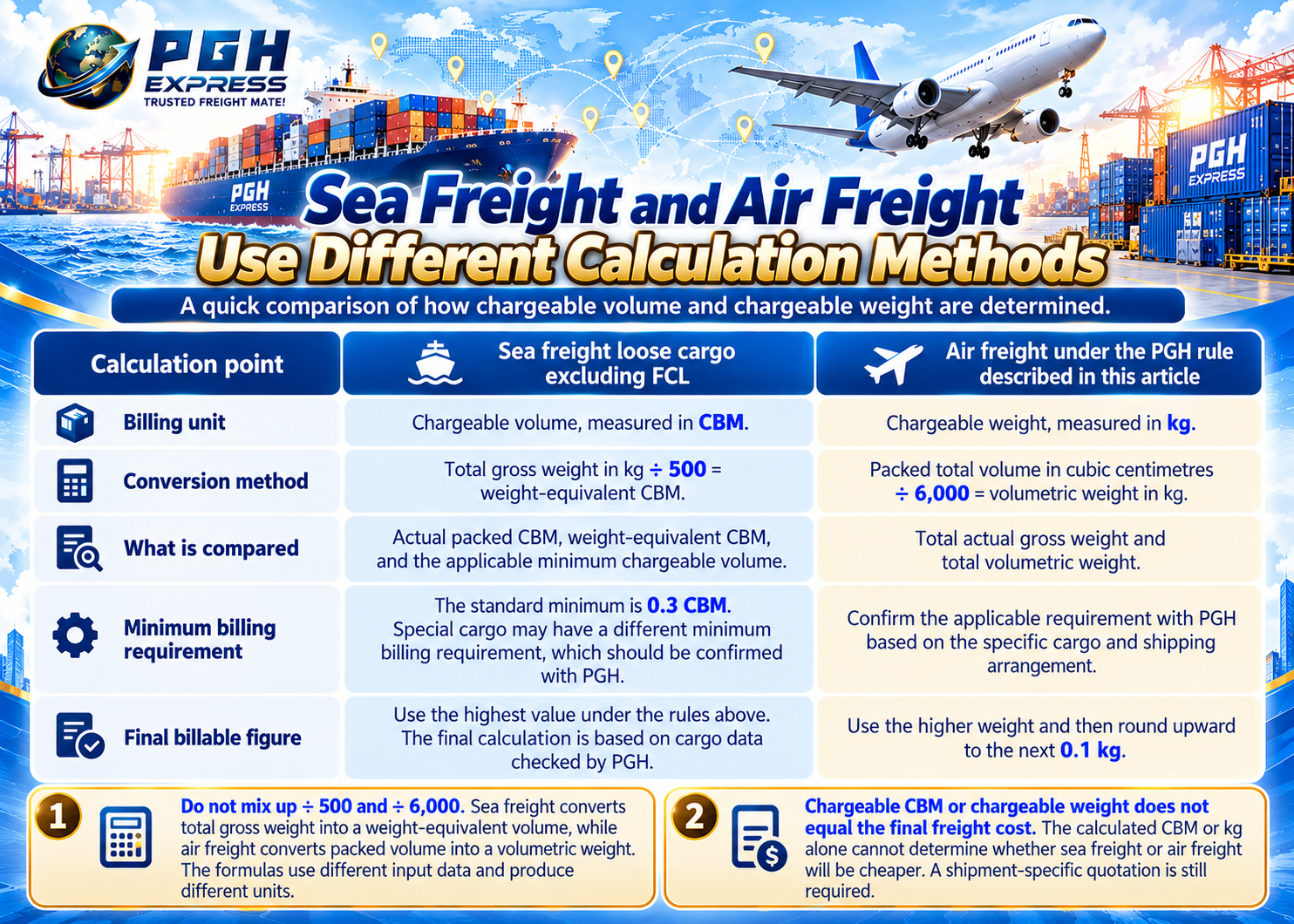
This infographic compares the billing unit, conversion method, comparison basis, minimum billing requirement, and final billable figure for PGH sea freight loose cargo and air freight.
What information should you prepare before requesting a quote?
Provide PGH Express with the following packed-cargo information:
- Product name and a short description.
- Number of cartons or other shipping packages.
- Packed length, width and height for each carton or each group of cartons with identical dimensions, including the measurement unit.
- Gross weight, clearly stating whether it is per carton or for the entire shipment.
- Pickup location in China and supplier details when available.
- Complete delivery address in the Philippines.
- Whether the shipment contains batteries, liquids, fragile goods or other cargo requiring special handling.
If packing is not yet complete, clearly mark the dimensions as estimates and indicate when the supplier expects to confirm the final measurements.
If carton quantity, packed dimensions or gross weight changes, provide an updated packing list. Photos can help explain the packaging condition, but they do not replace actual measurements.
Common mistakes when checking chargeable volume or weight
- Using product dimensions instead of packed dimensions. Measure the external shipping carton, crate or pallet.
- Confusing net weight with gross weight. Gross weight includes the packaging used for shipment.
- Multiplying by product quantity. The calculation requires the number of shipping packages with the stated dimensions.
- Assuming all cartons have the same dimensions. Different carton sizes should be calculated separately and then added together.
- Treating the 0.3 CBM sea freight minimum as a maximum. If actual volume or weight-equivalent volume is higher, the higher result still applies.
- Rounding air freight weight downward or using normal rounding. PGH rounds the final air freight chargeable weight upward to the next 0.1 kg.
- Treating the calculated CBM or kg as the final freight price. Chargeable volume and chargeable weight are calculation bases, not the final total shipping cost.
Frequently asked questions
Why can a sea shipment that physically measures 1 CBM be charged as 1.2 CBM?
Under the PGH rule, a shipment weighing 600 kg has a weight-equivalent volume of:
600 ÷ 500 = 1.2 CBM
This is higher than the actual volume of 1.0 CBM and the standard minimum of 0.3 CBM, so the chargeable volume is 1.2 CBM.
If a sea shipment is under 0.3 CBM, is it always charged as 0.3 CBM?
No. The standard 0.3 CBM minimum applies only when both the actual packed volume and the weight-equivalent volume are no higher than 0.3 CBM.
For example, 0.2 CBM and 40 kg results in a chargeable volume of 0.3 CBM. However, 0.2 CBM and 200 kg results in 0.4 CBM because 200 ÷ 500 = 0.4 CBM.
Special cargo may have a different minimum billing requirement, which should be confirmed with PGH.
Why can a lightweight air shipment be charged at a higher weight?
The packed dimensions may produce a volumetric weight that is higher than the actual gross weight. PGH compares the two values, uses the higher one, and then rounds the final chargeable weight upward to the next 0.1 kg.
Does packaging count in the calculation?
Yes. Use the external packed dimensions and the gross weight including packaging. Using unpacked product dimensions or net weight may understate the shipment data used for freight calculation.
What if the cartons have different dimensions?
Calculate each carton or each group of identical cartons separately. For sea freight, add the packed volumes together. For air freight, add the volumetric weights together. Then use the total gross weight of the shipment for the relevant comparison.
Do all shipping services use 500 kg per 1 CBM?
No. The 500 kg per 1 CBM conversion is the confirmed PGH billing conversion for sea freight loose cargo.
It is not a physical equation and does not apply to FCL, air freight or every logistics provider.
Can these examples be used to calculate the final freight cost?
No. The examples only calculate chargeable volume or chargeable weight. Provide the cargo and address details to PGH so the team can confirm the appropriate shipping arrangement and provide the complete quotation for the shipment.
Can the sea freight formula be used for FCL?
No. The total gross weight ÷ 500 conversion and the chargeable-volume comparison described in this article apply to PGH sea freight loose cargo and do not apply to full-container-load shipments.
The quotation basis for FCL should be confirmed separately with PGH.
Ask PGH to check the chargeable amount for your shipment
Is the supplier packing list ready? Send PGH Express the product name, carton quantity, packed dimensions, gross weight, pickup location in China and complete delivery address in the Philippines. Also identify any batteries, liquids, fragile goods or other cargo requiring special handling.
If any information is still estimated, clearly mark it as an estimate. Before shipment, the PGH team can check the chargeable CBM or kg and discuss the suitable shipping arrangement, applicable minimum billing requirement and complete shipment quotation.
You do not need to decide in advance whether the shipment should move as loose cargo or FCL. Send the cargo details and PGH can help determine the suitable shipping option.